Here is a shot of the brake plate from the Honda I’m working with for the Overland . I have gotten the two air holes cut and framed with screens. Still not sure how much I will do with the cross-over link. I’m waiting to get some help from my son to get the operating arm set up on the drill press for some holy work. Still slowly re-profiling both brake operating arms to suit my eye. I have pretty well convinced myself that I will also drill the brake drum hub for some air out-let holes. Just not sure when it will get done or even how.
Followers
Monday, April 30, 2012
Saturday, April 28, 2012
The Final Cast
I got my final cast the other day. To my great relief it is below the elbow. However that doesn’t really do much to make it possible to get back in the garage. Have more movement with my fingers but not enough to use tools, weld or do any of the things I had planned for these six weeks of spring.
Interesting process the new generation of casts. I have never broken anything that required a cast so I’m new to all of this. They used a 3M fiberglass fabric that was water activated. Very interesting process; just wish I had observed it being done to someone else. It is a decent French racing blue.
So in four more weeks I get this off and can get back to some serious catch-up in the garage.
Tuesday, April 17, 2012
What’s the frame from?
Since I’m disabled for six weeks I thought a good use of time might be data gathering to finalize the Overland frame design. I don’t remember where I snagged this image from. My only excuse for failing to remember is my broken wing. So any ideas as to what year and type of Triumph it’s from. More importantly anybody have an idea of what the head tube rake would be?
Sunday, April 15, 2012
Enforced Timeout by Stupid!!!!
Spring in Montana is an odd mix of warm and clear days mixed with cool and wet days. Seems this spring is going to be a mix of Rocky Mountain and Pacific Coast weather patterns. No sooner did I get the grocery trailer finished and the weather changed. And then the DIY projects got listed; none of which had to do with the Overland project. But they had to get done.
While working on the DIY list I was on the roof doing a small bit with the gutters. One thing not planned but completed was a test of gravity in a very unscientific manner. I fell of the roof and of course proved again that I can’t fly. The pay off on this impromptu test was a broken wrist.
Now you may think this was not so bad considering. Well actually it really sucks. Because the ortho doc is saying six weeks for the splint cast combination. But on the up side I’m in the middle of a trade/sale deal on some JAP spares which will take sometime to complete. So a timeout isn’t too bad. Well yes it does suck, it all sucks. In all reality everything in the garage is shut down till the cast comes off.
In the big picture of things considering the distance over which I conducted my test and the obstacles I missed, it all could have caused much greater damage and things could have turned out much worse. So all in all I think six weeks is not really too bad. But it still sucks!
The splint, a cast in two weeks.
Sunday, April 8, 2012
Spring in Montana!
Just two days ago we had snow on the ground and temperatures in the 30s and 20s. The continued cold spells have been in-between warmer days and nights. Each time we get a brief return of winter it melts away with the subsequent warmer air from the coast.
So everybody around here is thinking spring despite the sporadic snow and cold. Seed plants are growing in the basement. The grow boxes in the garden are all ready to go. The non-motorcycle list of things to do is growing.
After building a new deck last summer the good idea fairy appeared and my son thought it would be great if we put a hand built wrought iron railing on the deck. Well as you might expect dad got conscripted as the gopher on the railing project. Of course each and every bit of the railing has to be considered and evaluated before things get welded up. Of course that takes time; time away from my projects. In the big picture of things the CEO around here will be happy and son and dad will have gained favor to be spent at a later date.
Another of those things to do was to get the bicycle trailer finished and up and rolling on tires. Completed the hitch today and now I have a bicycle trailer all ready to go and get groceries with. It’s hard to see in the photo but everything but the hitch is recycled from a bike or other sources. Even the wheels and tires are from old bike projects left in my garage by my ever considerate son.
In a positive way all of this gets some little ankle biters behind me so as the weather gets more stable I can get more things done for the Overland .
As my oldest daughter has said, “It’s all good Dad!”
The grocery trailer ready to roll out!
Wednesday, March 14, 2012
Vintage Engine Pornography
So here I am minding my own business and from the same seller pops up another vintage engine that is so lovely I just want to bang my head on the wall. Yes I know that is over the edge and deep into pathetic.
I don’t know what it is but there is something unique, basic, primal and beautiful about the early single cylinder racing engines. They are perfect expressions of form follows function. They were built by men and not designed by computer or committee. Yes I know I’m writing all this on a computer.
So this is the latest offering. See it here if you dare. Buy it now is $175,000.00.
This is what he has to say about the engine.
Joe Petrali worked at Excelsior from 1926 to 1931 when the company closed because of the Great Depression. According to his Excelsior contract, Joe rode a 45" Twin Super X in hill climbs and board track races. Petrali had been racing and winning on Excelsior's factory race team since 1925. Excelsior did not make a racing machine for dirt track racing where engines were restricted to 21.35" or 350cc. At the direction of Ignatz Schwinn, the owner of Excelsior, Joe began developing a 21.35 " OHV racing single of his own design to qualify for the dirt track class. His life long friend and fellow racer, Gene Rhyne, former racing department engineer for indian, teamed up with Joe at Excelsior to build the 21.35" dirt track racer. The first and only 21" racing machine was assembled with this 21.35" OHV dual port single racing engine by Joe and Gene at the Excelsior plant in
When finished, the machine was prepped by Joe and Gene and taken by them to
Gene Rhyne went to work for Al Crocker in
Gene Rhyne and Pete Smiley, a noted racing personality, rebuilt this Excelsior engine in the late 1970's. The engine has not run since the rebuild. Engine turns over and has good compression. This one off engine could be used for display or be rebuilt into a dirt track racing machine. It may require some cosmetics, inspection, and tuning.
Well I just figured out what the value of one of my kidneys is!
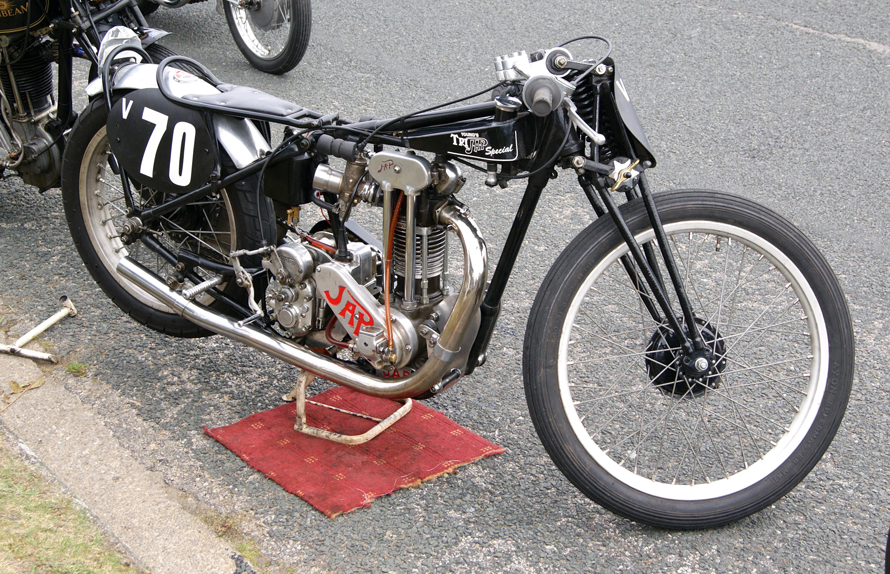
But if I push back the lust and focus my attention by quieting the internal dialog I remember that I have this in the Kiotee Garage. Well actually I have two like this.
Tuesday, March 13, 2012
HISTORY?
It's no secret I’m a JAP engine addict. In fact I belong to a Facebook group which is dedicated to the JAP engine. And as such members will post photos and info and just general goings on regarding JAP. And of course notes regarding JAP engines that pop up from time to time being for sale. Well I saw this 1936 JAP engine for auction and was a bit stunned to see a buy it now price of $17,900.00. That price makes my race engine seem cheap in comparison. But as of now there had been no sale. We shall see what happens. It is a fine engine which is supposed to be complete and rebuilt 30 years ago.
This is the history part. The same guy that is selling the JAP also is selling a Harley Davidson 500 cc single race engine which is one of the prototype engine built to run against the JAP. The buy it now price is $199,000.00. Yes I read and typed that correctly. This is what the seller says about the engine.
Circa 1933 one-off Harley Davidson Over Head Valve 500cc, 30.50 cubic inch single cylinder racing engine. This experimental engine is the predecessor of the Harley Davidson CAC 500cc Speedway single racers. This engine is a virtual copy of the J.A. Prestwich, also known as J.A.P. Speedway 500cc, 4 stud racing engine manufactured in Tottenham, England from the teens to the 1960's. The J.A.P. Speedway machines were beating all comers including Harley Speedway racers. The Harley racing department decided it was time to even the score. A brand new J.A.P. 4 stud Speedway machine was purchased by the Harley race department. Their express purpose was to dismantle and reverse engineer the OHV J.A.P. engine to improve Harley's raing performance by incorporating some of the J.A.P. designs. William Harley and Joe Petrali, scratch built this one-off Harley Speedway engine copying a J.A.P. single in the Harley race department. William Harley told Petrali to discard the J.A.P. parts. but soon realized they could reuse the carburetor and magneto off the J.A.P. engine. He asked Joe what became of the carb and mag? Joe replied he threw them in the trash as instructed. Harley told him to go retrieve them, which he did. The original Amal racing carburetor and the Lucas racing magneto were found and installed on this Harley one-off racing engine. They remain in use on it today.
The Harley Davidson engine turns over and has good compression. This is the original untouched engine as given to Joe Petrali by William Harley at the end of their project. At the base of the cylinder, "EX 1320" is cast indicating it is an experimental item. The brand name, "Harley Davidson" is in bas relief on the rocker box cover similar to where the J.A.P. engine has J.A.P. in bas relief. Other than "EX 1320" cast on the cylinder and "Harley Davidson" in bas relief on the cover, there are no VIN , line bore, or date code numbers. The engine case castings are rough and crude where reinforced around the crankpin. The compensating sprocket is on the sprocket shaft. Use as a show engine or build a truly one of a kind Speedway racing machine.
I have always read bits and pieces which suggested that Crocker, Indian and Harley copied the JAP with apparently no shame at all from the looks of it. But what I don’t understand is for how simple the JAP really is and if Crocker, Indian and Harley used in hand examples of the JAP to copy why couldn’t they beat the JAP engines? Or at least build an engine as good as the JAP? That may be a mystery of the universe questions I’m thinking.
Be that as it may, if I had some big lotto winnings in my pocket I would have the Harley engine winging it’s way to the Kiotee Garage along with a Crocker single and an Indian if I could prey one out of somebody’s fingers.
Memory refresher for all and a bit of engine porn tossed in for good measure.
1928 Indian
500 OHV Crocker
So I guess nothing left to do but go out to the Kiotee Garage and fondle my superior JAP race engines.
Subscribe to:
Posts (Atom)